
Invoice vs Receipt:-
Invoice vs Receipt: What’s the Difference and Why It Matters: –
Invoicing Guide for Freelancers & Small Business Owners | 5 min read :
If you’ve ever sent a receipt when you should have sent an invoice — or confused invoice vs receipt — you’re not alone. For freelancers and small business owners, these two documents look similar and both relate to payment, but they serve completely different roles in your financial workflow.
Mixing them up can delay payments, create bookkeeping headaches, and cause problems at tax time. This invoice vs receipt guide breaks down exactly what each document is, when to use each one, and what happens when you get it wrong.
Want a smarter way to manage invoices and receipts?
The One-Line Answer:-
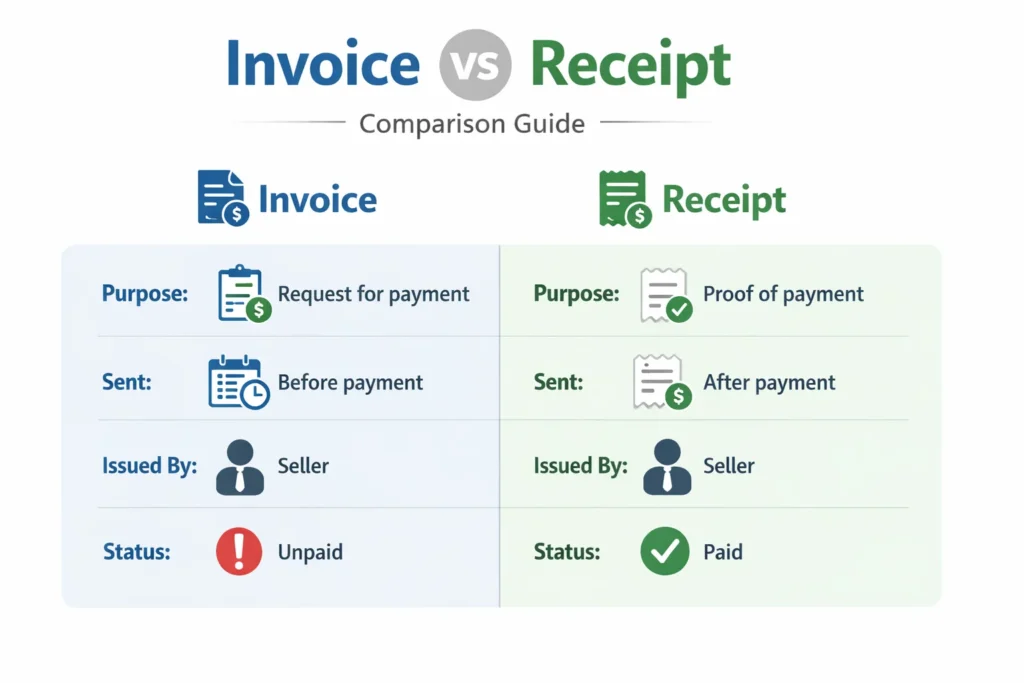
In the invoice vs receipt comparison, the key difference is simple: An invoice requests payment. A receipt proves payment was made.
That’s the core distinction. Everything else flows from it. An invoice comes before money changes hands; a receipt comes after. One creates a payment obligation; the other closes it.
Invoice vs Receipt: What Is an Invoice?
An invoice is a formal payment request you send to a client after delivering a product or service. It tells them what they owe, how much, and when it’s due. Sending an invoice is how you trigger the payment process — without one, most business clients have no formal record that payment is expected.
Every invoice should include:
- Your business name, address, and contact details.
- Your client’s name and billing address.
- A unique invoice number (e.g., INV-2026-042).
- The invoice date and payment due date.
- Itemized description of services or goods with quantities and rates.
- Subtotal, applicable taxes, and total amount due.
- Accepted payment methods and any late fee terms.
Invoices create a legal payment obligation once received by the client. They form your accounts receivable record — open invoices tell you exactly who owes you and how much. They provide the documentation tax authorities need to verify your business income. And they give corporate clients the formal document their accounts payable department requires to process payment.
Need a quick invoice right now?
Want to automate everything?
Invoice vs Receipt: What Is a Receipt?
A receipt confirms that payment has been received. You issue it after the money arrives — not before. It closes the loop on a transaction and gives your client written proof that their payment was recorded.
A receipt typically includes:
- The seller’s business name and contact information.
- The buyer’s name.
- The date payment was received.
- The amount paid.
- The payment method (bank transfer, credit card, cash, etc.).
- A reference to the original invoice number, if applicable.
- A unique receipt number.
Receipts matter more to buyers than sellers in most cases. Your clients may need them to claim business expenses and tax deductions, get reimbursed by their employer for business costs, provide proof of purchase for warranty or refund requests, or satisfy their own internal accounting requirements.
Invoice vs Receipt: Side-by-Side Comparison:
This invoice vs receipt comparison clearly shows how both documents differ in purpose and timing.
| Items | Invoice | Receipt |
| Purpose | Requests payment | Confirms payment was made |
| Timing | Sent before payment | Issued after payment |
| Creates | A legal payment obligation | Proof that obligation is fulfilled |
| Contains | Due date, payment terms, line items | Payment date, method, amount paid |
| Used for (seller) | Accounts receivable tracking | Income confirmation |
| Used for (buyer) | Accounts payable processing | Expense claims & tax deductions |
| Tax role | Documents revenue | Documents deductible expenses |
The Transaction Timeline: Where Each Document Fits:
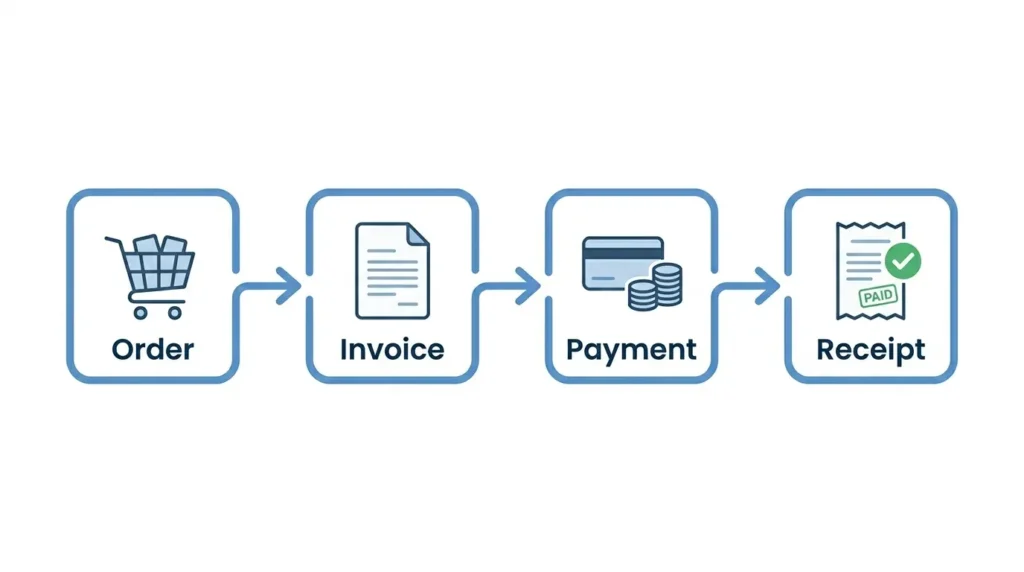
To better understand invoice vs receipt, visualizing the order of events makes the distinction clear. For a typical freelance project, the document flow looks like this:
1. Work completed → 2. Invoice sent → 3. Client pays → 4. Receipt issued.
The invoice sits between steps 1 and 3. The receipt comes after step 3. This timeline is fixed — you cannot issue a receipt before payment has actually cleared, and you shouldn’t send an invoice after the fact to cover a payment that’s already been made.
For point-of-sale businesses like retail stores or restaurants, the invoice step is often skipped entirely because payment happens immediately at checkout. In that case, a receipt is all that’s needed. But for service-based businesses — freelancers, consultants, contractors — the invoice is the essential first step.
Common Scenarios for invoice vs receipt : What to Send and When: –
These examples will help you understand invoice vs receipt in real situations:
Scenario 1: Standard freelance project: –
You complete a web design project and deliver the files. You send an invoice for $1,500 with Net 15 payment terms. Two weeks later the client pays. You then send a receipt — or a copy of the invoice marked “PAID” — confirming you’ve received the funds.
Scenario 2: Large project with a deposit: –
You’re building a $5,000 brand identity. Before starting, you invoice for a 50% deposit ($2,500). Once that clears, issue a receipt. When the project wraps, invoice for the remaining $2,500. On final payment, issue a second receipt. You end up with two invoices and two receipts — a clean paper trail for the whole project.
Scenario 3: Monthly retainer client: –
You invoice on the 1st of every month for your ongoing social media management. Receipts go out as each monthly payment arrives. Both documents stack up chronologically, giving you and your client a clear record of the entire engagement.
Scenario 4: Immediate cash or card payment: –
You’re a consultant who sometimes gets paid on the spot. In this scenario you can issue a receipt directly — though even here, many accountants recommend sending an invoice first to create the formal record.
Can a Paid Invoice Serve as a Receipt?
Yes — with conditions. A paid invoice can function as a receipt if it clearly shows:
- The word PAID, prominently displayed
- The date payment was received
- The payment method used
- A zero-balance due
Many freelancers and small business owners use this approach to keep things simple. Instead of generating a separate receipt document, they mark the original invoice as paid and send that back to the client. This works well for straightforward transactions.
For larger corporate clients or clients in jurisdictions with strict documentation requirements, a separate formal receipt is better practice.
What Happens When You Mix Them Up?
When it comes to invoice vs receipt, using the wrong document at the wrong time has real consequences:
- Sending a receipt before payment implies the transaction is done — if payment then fails or bounces, you have no record of an outstanding balance.
- Sending an invoice after the fact to document a payment already made creates a confusing paper trail that can cause problems during tax audits.
- Some corporate clients’ accounts payable systems will not process a receipt as a payment request — they need a formal invoice to release funds
- Claiming business expense deductions with invoices instead of receipts may not satisfy tax authorities, who typically require proof of payment for expense claims
The Tax Angle: Why Both Documents Matter: –
From a tax perspective, understanding invoice vs receipt is essential for accurate reporting. Invoices document your income. Tax authorities use them to verify that you correctly reported what you earned.
Receipts document your expenses. If you’re claiming a business deduction, you’ll typically need a receipt — not just an invoice — as proof that payment was actually made.
As a rule of thumb, keep both invoices and receipts for a minimum of 3 to 7 years. Tax authorities in most countries can audit returns from several years back, and missing records at that stage creates serious complications.
A Note on Record-Keeping: –
Paper records are increasingly impractical and, in some jurisdictions, no longer acceptable. Storing both documents digitally — in a consistent, searchable system — is now considered best practice. The simplest approach:
- Use invoicing software that automatically stores all issued invoices in your account
- Issue receipts through the same tool so they’re linked to the corresponding invoice
- Back up records to cloud storage at least monthly
- Organise files by year and client so you can pull up any transaction quickly
Quick Reference: Which Document Do You Need?
Send an invoice when:
- You’ve just completed work and payment hasn’t been made yet
- A client needs a formal payment request to process through their accounts payable
- You’re billing for a deposit or milestone payment on an ongoing project
- You have payment terms (Net 15, Net 30, etc.) that create a future due date
Issue a receipt when:
- A client has paid and wants written confirmation their payment was received
- A client needs documentation for an expense claim or reimbursement
- You receive immediate payment at point of service and no prior invoice was sent
- A client requests proof of payment for warranty, refund, or insurance purposes
The Bottom Line:-
The invoice vs receipt difference is not just technical — it directly impacts your business operations. Invoice and receipt are not interchangeable terms for “billing document.” They describe two distinct events in a transaction — the request for payment and the confirmation of payment — and each has a specific job to do.
Getting this right costs you nothing. Getting it wrong can cost you time, money, and credibility with both clients and tax authorities. For freelancers and small business owners, the habit of sending the right document at the right time contributes to a well-organized and smooth process, financial management and overall business efficiency.
Stop managing invoices manually — upgrade your workflow today.