
How to Follow Up on an Unpaid Invoice: Email Templates That Get You Paid.
Late payments are one of the most stressful parts of running a freelance business or small company. You delivered great work, met every deadline, and sent your invoice on time — and then nothing. The due date passes. Days turn into weeks. And you’re left wondering how to follow up on an unpaid invoice without sounding desperate, aggressive, or unprofessional.
The good news: most late payments are not intentional. Research consistently shows that the majority of overdue invoices are caused by forgetfulness, administrative delays, or the invoice landing in the wrong inbox — not bad intent. A well-timed, professionally worded follow-up email is usually all it takes to get the money moving.
This guide gives you a complete unpaid invoice follow-up system — including a day-by-day timeline, five copy-paste invoice follow-up email templates for every stage, a comparison of approaches, and practical tips to reduce late payments in the first place.
Why Freelancers Struggle to Follow Up on unpaid invoices:
Most freelancers follow up once, feel awkward about it, and then go quiet. That silence is expensive.
According to industry research, 85% of freelancers experience late invoice payments at some point in their career. The average freelancer is owed thousands in overdue payments at any given time. Yet the same research shows that a structured, consistent follow-up sequence recovers the vast majority of those payments — often within the first two reminders.
Main issue is not that clients refuse to pay. The problem is that most freelancers give up too early or follow up inconsistently.
A professional overdue invoice email sequence does three things: it keeps your invoice at the top of the client’s mind, it creates a documented paper trail, and it signals that you run your business seriously. Clients who know you follow up consistently also tend to prioritize your invoices over those from freelancers who stay silent.
The discomfort you feel about asking for payment is real. But the cost of not asking is greater.
The Golden Rule: Tone Escalates with Time:
Before diving into templates, understand the single most important principle of invoice follow-up: your tone should escalate gradually as the invoice ages.
Early reminders are friendly and assume good faith. Middle-stage reminders are polite but direct. Late-stage reminders are firm and reference consequences. This approach protects the client relationship while making it clear you are serious about being paid.
Jumping straight to a stern email on day one damages relationships unnecessarily. Staying friendly on day 60 signals that there are no real consequences for ignoring you. The staged approach hits the right note at every point in the process.
The Complete Follow-Up Timeline:
Here is the recommended follow-up sequence for an unpaid invoice, from the first reminder through final escalation:
| Stage | Timing | Tone | Goal |
|---|---|---|---|
| Reminder 1 | 1–2 days before due date | Friendly | Prompt early payment |
| Reminder 2 | 1 day after due date | Polite, assumptive | Catch forgetfulness |
| Reminder 3 | 7 days overdue | Firm, direct | Create urgency |
| Reminder 4 | 14 days overdue | Serious, consequence-focused | Signal consequences |
| Reminder 5 | 30 days overdue | Final notice | Last chance before action |
| Escalation | 45+ days overdue | Formal | Move to collections / legal action |
Most invoices get paid within the first two reminders. If you reach reminder 5, you are dealing with a genuinely difficult payment situation and should be prepared to escalate.
05 Invoice Follow-Up Email Templates (Copy and Paste):
Each email template below corresponds to one stage of the timeline above. Customize the placeholders in brackets before sending.
Template 1 — Friendly Pre-Due Reminder (1–2 Days Before Due Date):
Subject: Friendly reminder — Invoice [#NUMBER] due [DATE]
Hi [Client Name],
Hope you’re having a good week. Just a quick heads-up that Invoice [#NUMBER] for [project name] is due on [DATE].
Total amount: [AMOUNT] Payment methods: [list your accepted methods]
If you have any questions about the invoice or the work covered, feel free to reach out. Otherwise, no action needed until the due date.
Thanks again for the project — it was great working with you.
[Your Name]
Template 2 — Polite Post-Due Reminder (1 Day After Due Date):
Subject: Invoice [#NUMBER] — just checking in
Hi [Client Name],
I wanted to follow up on Invoice [#NUMBER] for [AMOUNT], which was due yesterday on [DATE].
If payment is already on its way, please ignore this — sometimes things cross in transit. If not, I’d appreciate it if you could process it at your earliest convenience.
Invoice details:
- Invoice number: [#NUMBER]
- Amount due: [AMOUNT]
- Original due date: [DATE]
- Payment link / bank details: [DETAILS]
Let me know if you need anything from my side.
Thanks, [Your Name]
Template 3 — Firm Reminder (7 Days Overdue):
Subject: Invoice [#NUMBER] — 7 days overdue
Hi [Client Name],
I’m following up again on Invoice [#NUMBER] for [AMOUNT]. This invoice is now 7 days past its due date of [DATE] and remains unpaid.
I understand things can get busy. Could you let me know the status of this payment, or provide an expected payment date? If there’s an issue with the invoice itself, I’m happy to address it quickly.
Invoice summary:
- Invoice number: [#NUMBER]
- Amount due: [AMOUNT]
- Due date: [DATE]
- Days overdue: 7
Please use the payment details below: [Payment link / bank details]
Thank you, [Your Name]
Template 4 — Serious Notice (14 Days Overdue):
Subject: Urgent — Invoice [#NUMBER] now 14 days overdue
Hi [Client Name],
Invoice [#NUMBER] for [AMOUNT] is now 14 days past due. Despite my previous follow-ups, I have not received payment or an update on when to expect it.
As noted in my original payment terms, a late fee of [X%] per month applies to balances unpaid beyond [your terms]. I would like to resolve this without adding late fees, but I will need to hear from you within 48 hours.
Please confirm payment status or arrange payment using the details below: [Payment link / bank details]
If there is a genuine issue — such as a billing dispute or cash flow difficulty — please reply and we can discuss a resolution.
[Your Name]
Template 5 — Final Notice (30 Days Overdue):
Subject: Final notice — Invoice [#NUMBER] | Action required
Hi [Client Name],
This is a final notice regarding Invoice [#NUMBER] for [AMOUNT], which is now 30 days overdue.
I have followed up several times without receiving payment or a response. If payment not receive to me or written communication within 5 business days, I will have no choice but to explore further options, which may include referring this matter to a collections agency or pursuing it through small claims court.
I would strongly prefer to resolve this directly. Please contact me immediately to arrange payment or discuss the situation.
(Your Name) (Your Business Name) (Your Phone Number)
Comparison between Manual Followup and Ayotmated Follow-up:
| Factor | Manual Follow-Up | Automated Follow-Up |
| Time Cost | 10–20 minutes per invoice | Near zero once set up |
| Consistency | Depends on your memory | Always on time, for every invoice |
| Personalization | High — fully customizable | Medium — template-based |
| Best For | High-value clients, complex situations | Regular clients, recurring invoices |
| Risk | Easy to forget, inconsistent | Can feel impersonal if not customized |
| Cost | Free | Requires invoicing software |
| Payment Speed | Variable | ~23% faster on average |
Verdict: For high-value, one-off clients, a personalized manual follow-up is more effective. For recurring clients and regular invoicing, automation saves significant time and improves consistency. Most freelancers benefit from a hybrid — automate the first two reminders and handle later-stage follow-ups personally.
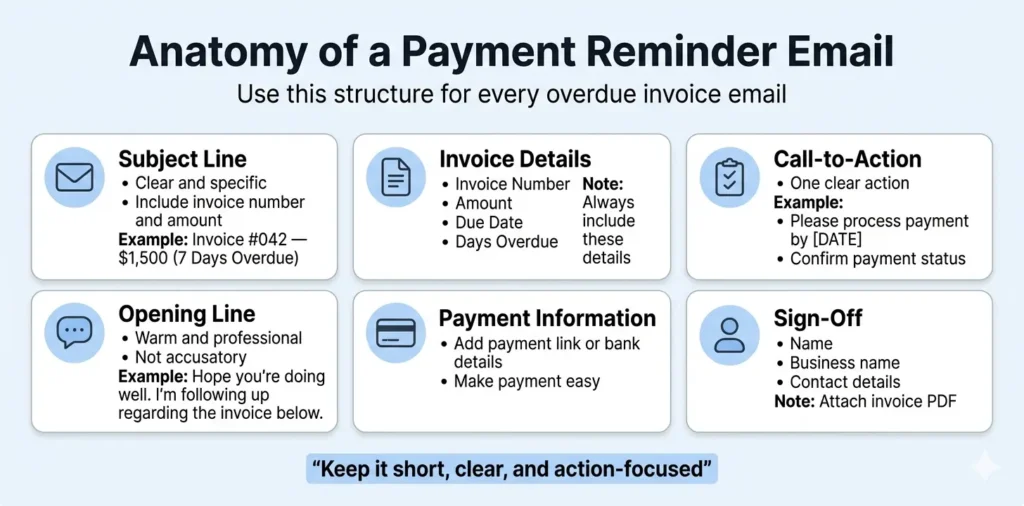
The Anatomy of a Payment Reminder Email:
How to Ask for Payment Politely Without Feeling Awkward:
The discomfort around chasing overdue invoices is the number one reason freelancers leave money on the table. Here are five mindset shifts that make it easier:
1. You are not asking for a favour. You completed the work. Payment is a contractual obligation, not a request.
2. Most delays are not personal. The invoice landed in spam. The client’s accounts payable contact was on leave. The payment got stuck in a queue. Assume a logistical problem first, not bad faith.
3. Short and specific beats long and apologetic. A brief, clear email gets read and acted on. A long, over-explained email signals anxiety and gets ignored.
4. Silence is the worst option. if you wait longer to send an unpaid invoice reminder, the chance of getting paid will be lower. Every day of silence signals that there are no consequences for delay.
5. Following up is professional, not pushy. Corporate accounts payable departments expect and rely on reminders. Sending them is standard business practice, not an imposition.
Six Things That Prevent Late Payments Before They Start:
The best way to handle a late payment is to prevent it. These six habits dramatically reduce how often you need to send overdue invoice emails:
Shorter payment terms. Net 30 is the industry default, but Net 15 or even Net 7 is perfectly reasonable for freelancers. The shorter the window, the less time for payment to drift.
Upfront deposits. A 25–50% deposit before work begins ensures you are never fully unpaid for a project. It also filters out clients who are not serious.
Clear late fee terms. State your late fee policy on every invoice — typically 1.5–2% per month on overdue balances. Clients who see this take due dates more seriously.
Payment links in every invoice. The more steps between a client and payment, the longer it takes. A clickable payment link removes friction entirely.
Invoice immediately after delivery. Every day you delay sending the invoice adds a day to when you get paid. Invoice the same day you deliver.
Automated reminders. Set up pre-due and post-due reminders through your invoice generator software so no invoice falls through the cracks, even during busy periods.
When to Stop Chasing and Escalate:
If you have sent five follow-ups over 45 days with no payment and no response, it is time to move beyond email. Your options at this point include:
Collections agency. They pursue payment on your behalf, typically keeping 25–50% of the recovered amount. Worth considering for invoices over $1,000.
Small claims court. Most countries have a small claims process for disputed amounts under a set threshold (commonly $5,000–$10,000). The filing fee is low and you do not need a lawyer. The formal notice alone often prompts payment.
Formal legal letter. A letter from a solicitor or attorney, even without filing a case, signals that you are serious and often results in quick payment.
Pause future work. If this is an ongoing client, pausing new work until the outstanding balance is cleared is entirely reasonable and legally sound in most jurisdictions.
Before escalating, review your original contract. If you have a signed agreement with clear payment terms, your position is significantly stronger in any dispute.
Quick Reference: Do’s and Don’ts of Invoice Follow-Up:
| DO | DON’T |
| Follow up the day after the due date | Wait weeks before sending the first reminder |
| Keep emails short and specific | Write long, apologetic paragraphs |
| Include invoice number and amount in every email | Make clients search for their own invoice |
| Attach the original invoice PDF | Assume they still have it |
| Escalate tone gradually | Jump straight to threats |
| Document all follow-up attempts | Rely on memory alone |
| Offer a payment plan if needed | Ignore genuine hardship |
| Know when to escalate | Chase indefinitely without action |
The Bottom Line:
Learning how to follow up on an unpaid invoice is one of the most valuable business skills a freelancer or small business owner can develop. It protects your income, maintains your cash flow, and signals to clients that you run a professional operation.
The system is simple: follow up early, escalate gradually, stay consistent, and know when to take action. Use the invoice follow-up email templates in this guide as your starting point, customize them to fit your voice, and set up automated reminders so the process runs without you having to think about it.
The goal is to get paid for work you have already done — and you deserve nothing less.